Table of Contents
ToggleVaulted ceilings in an open concept living room and kitchen create drama, volume, and a sense of luxury that flat ceilings just can’t match. But making those soaring spaces feel cohesive and comfortable takes more than just knocking down a few walls and hoping for the best. From lighting placement to heating costs, there’s real planning involved. This guide walks through the design considerations, practical challenges, and finishing touches that turn a cavernous shell into a thoughtfully designed home that actually works for everyday living.
Key Takeaways
- Vaulted ceilings in open concept living rooms and kitchens amplify the sense of flow and create dramatic visual volume, but require careful planning for proportional furniture scale, lighting placement, and climate control.
- Proper HVAC zoning, ceiling fans in reverse mode, and high/low return air placement are essential to manage heating costs and avoid cold spots under vaulted ceilings that allow hot air to rise.
- Layered lighting—including recessed cans on sloped ceilings, eye-level pendant lights, and wall sconces—is critical because a single fixture cannot adequately illuminate high ceiling spaces.
- Visual zoning without walls relies on flooring transitions, area rugs, oversized islands, and accent walls rather than dropped soffits, since traditional ceiling elements don’t work in open vaulted layouts.
- Furniture and décor must be scaled up—oversized art (4×6 feet or larger), tall bookcases, and substantial pendant lights—to fill the vertical void and prevent small pieces from appearing lost under soaring ceilings.
- Acoustic challenges from hard surfaces and high ceilings should be addressed with soft materials like curtains, rugs, upholstered furniture, and decorative ceiling panels to reduce echo.
Why Vaulted Ceilings Transform Open Concept Spaces
Vaulted ceilings pull the eye upward, making even modest square footage feel expansive. In an open concept layout, that vertical volume amplifies the sense of flow between the kitchen and living areas, there’s no visual ceiling line cutting the space in half.
From a structural standpoint, vaulting a ceiling means eliminating or altering ceiling joists and exposing the underside of the roof framing. Cathedral ceilings follow the roofline symmetrically, while barrel or groin vaults require custom framing. Either way, you’re dealing with the roof structure, which often means involving an engineer and pulling permits if this is a retrofit project.
The payoff? Natural light travels farther. A well-placed clerestory window or skylight near the peak floods both the kitchen and living zones without adding wall penetrations. And because the ceiling plane isn’t interrupted, paint color, wood beams, or even board-and-batten treatments become a unifying design element across the entire open floor plan.
But vaulted ceilings aren’t just aesthetic. They affect HVAC performance, acoustics, and even resale value. Homes with dramatic ceiling treatments often command higher prices, but only when the space is properly finished and climatically functional.
Design Considerations for Open Concept Vaulted Ceiling Layouts
Balancing Proportions and Scale
A 20-foot vaulted ceiling over a 12×14-foot living room can feel more like a gymnasium than a cozy gathering space. Scale matters. As a rule of thumb, ceiling height should relate proportionally to room width, roughly 1:1.5 to 1:2 works for most residential layouts. If the vault peaks at 18 feet, the combined open space should ideally span at least 24–30 feet in width.
Furniture scale needs to adjust, too. Standard 32-inch tall sofas and 18-inch side tables get visually lost under soaring ceilings. Taller bookcases, oversized art (think 4×6 feet or larger), and substantial light fixtures help fill the vertical void. Even window treatments should extend higher, mount drapery rods closer to the ceiling or vault peak to draw the eye up and make the window feel taller.
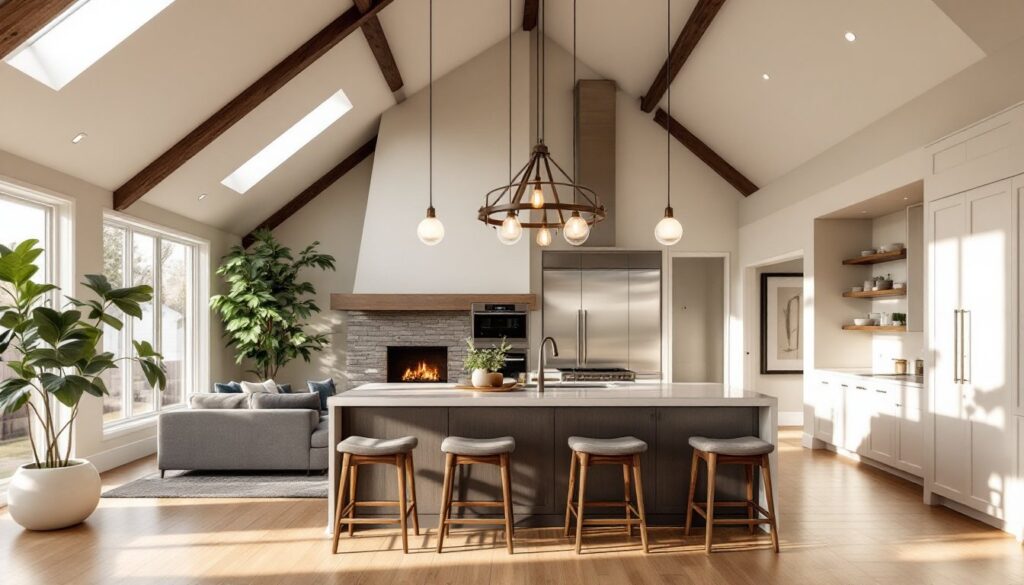
Exposed beams or timber trusses are a practical way to break up an otherwise empty ceiling plane. A structural ridge beam at the peak, with collar ties or scissor trusses below, adds visual interest and gives the eye something to rest on. If you’re retrofitting, these elements may be decorative (non-load-bearing faux beams), but in new construction they’re often structural. Consult your local building code, IRC R802 governs roof framing, and alterations to load-bearing members require engineered plans.
Creating Visual Zones Without Walls
Open concept doesn’t mean “one big undifferentiated box.” Vaulted ceilings make zoning trickier because you can’t rely on ceiling soffits or dropped headers to define areas. Instead, use flooring transitions, area rugs, and furniture arrangement.
A 9×12-foot or larger area rug anchors the living zone. In the kitchen, a shift from hardwood to large-format tile (12×24-inch or bigger) signals the functional workspace. If the vault runs the length of both spaces, consider a painted accent wall or board-and-batten wainscoting that runs vertically, this creates a visual endpoint without blocking sightlines.
Island placement is critical. A large kitchen island (at least 4×8 feet with seating on one side) acts as a natural divider between cooking and lounging zones. Pendant lights over the island, hung at 30–36 inches above the counter, help establish that boundary at eye level, even when the ceiling is 18 feet overhead. Designers on platforms like Houzz frequently showcase how oversized islands serve dual roles as both workspace and social hub in vaulted open layouts.
Lighting Strategies for High Ceilings in Open Floor Plans
Lighting a vaulted open concept space requires layering: ambient, task, and accent. A single ceiling fan with a light kit won’t cut it.
Start with recessed cans on sloped ceiling–rated housings. These are specifically designed for angled installations and meet NEC 410.116 requirements. Space them roughly 4–6 feet apart along the slope, aiming downward to wash the walls and avoid dark corners. Use LED retrofits rated for damp locations if the vault is near a kitchen range or bathroom.
Pendant lights are your eye-level workhorses. Over the kitchen island, hang three pendants in a row or a single linear fixture. The bottom of the shade should sit 30–36 inches above the counter. In the living area, a large drum pendant or wagon-wheel chandelier (48–60 inches in diameter for big spaces) draws the eye and anchors the seating group. Make sure it’s on a dimmer, high ceilings need flexibility between task lighting and ambient glow.
Track lighting or cable systems work well on vaulted ceilings because you can adjust the angle of each head. Run a track parallel to the ridge beam, with heads angled toward artwork, shelving, or architectural features. This is especially useful if you have exposed beams you want to highlight.
Don’t overlook wall sconces and floor lamps. Sconces mounted at 60–66 inches off the floor bring light back down to human scale and create pools of warmth in seating areas. A tall arc floor lamp (7–8 feet) next to a sofa adds task lighting for reading without requiring ceiling work.
Finally, natural light. Skylights or clerestory windows at the vault’s peak can flood the space with daylight, but they also introduce heat gain and potential leaks. Use low-E glazing and install them on north-facing slopes when possible. Operable skylights (manual or electric) help with ventilation, hot air rises, and a vent at the peak exhausts it efficiently.
Heating, Cooling, and Acoustics: Practical Solutions
Vaulted ceilings are beautiful until you get your first winter heating bill. Hot air rises, and without proper HVAC design, you’ll heat the upper third of your vault while your feet stay cold.
HVAC Sizing and Zoning: A vaulted open concept typically requires a larger-capacity furnace or heat pump because you’re conditioning more cubic footage. Work with an HVAC contractor to run a Manual J load calculation, don’t just guess. Consider a zoned system with separate thermostats for upstairs and main-floor areas, or at least programmable dampers.
Ceiling Fans: Install a fan with a downrod long enough to position the blades 8–9 feet off the floor, even if your ceiling peaks at 18 feet. In winter, reverse the fan to push warm air back down. A 60–72-inch fan works for spaces up to 400 square feet: larger layouts may need two.
Insulation: Vaulted ceilings over conditioned space must meet IRC energy code minimums (typically R-38 to R-49 depending on climate zone). If you’re retrofitting, spray foam or rigid foam between rafters is common, followed by a finish material. Don’t compress batt insulation, compressed R-value drops fast.
Acoustics: Hard surfaces (drywall, wood, tile) plus high ceilings equal echo. Add soft materials strategically: heavy curtains, upholstered furniture, area rugs with thick pads, and even acoustic panels disguised as art. If the kitchen island has a stone or quartz top, balance it with fabric barstools and a runner rug in the living zone. Some homeowners featured in renovation galleries on Homify use decorative ceiling clouds or baffles, suspended fabric or wood panels that absorb sound without dropping the entire ceiling.
Ductwork and Returns: Make sure return air grilles are located both high (to pull warm air) and low (to circulate cooler air). A single return at floor level won’t effectively pull air from a 20-foot peak. Talk to your HVAC tech about high-wall or ceiling-mounted returns.
Decorating Tips to Maximize Your Vaulted Open Concept
Paint and Color: Dark colors on a vaulted ceiling can make the space feel cozier, but they also absorb light. If you go bold (navy, charcoal, deep green), make sure your lighting plan compensates. White or light gray reflects light and emphasizes volume, standard builder white (e.g., Swiss Coffee, Alabaster) works, but a warm off-white prevents the space from feeling sterile. Paint coverage for vaulted ceilings is tricky to estimate: plan on 350–400 square feet per gallon for textured drywall, and use an extension pole and angled brush for edges.
Wood and Beams: Staining or painting exposed beams adds warmth and breaks up monotony. A medium walnut or weathered oak stain contrasts nicely with white drywall. If your beams are decorative (hollow faux beams), they’re lightweight and can be installed with construction adhesive and screws into blocking. Real structural beams, especially reclaimed timbers, need proper engineering.
Window Treatments: For tall windows flanking a vaulted living area, motorized shades or drapery tracks make life easier. Manual cords on 14-foot-tall windows are a hassle. If budget is tight, leave upper windows bare and treat only the lower operable sections.
Vertical Decor: Hang art in gallery clusters that extend vertically, or use a single oversized piece (5×7 feet or larger). Tall indoor plants, fiddle leaf figs, bird of paradise, or even a 10-foot bamboo, fill vertical space and add life without permanent installation. Ladder-style shelving (7–8 feet tall) serves the same purpose and offers display space.
Fireplace and Focal Points: A floor-to-ceiling stone or brick fireplace surround can anchor one end of the vault. If you’re building new or remodeling, extend the chimney chase or decorative surround all the way to the peak. Mount the TV on an articulating arm or within a built-in niche at standard viewing height (center of screen 42–48 inches off the floor), not halfway up a 20-foot wall.
Safety Note: Any work involving structural changes to ceiling joists, rafters, or beams requires a permit and often an engineer’s stamp. DIYers can handle finishes, paint, lighting, and decor, but don’t cut or remove framing members without professional guidance. Local building codes (IRC Chapter 8 for roof-ceiling construction) and snow/wind load requirements vary by region.