
Table of Contents
ToggleGrey curtains have become the go-to window treatment for modern living rooms, and it’s easy to see why. They’re neutral without being boring, they work with nearly every color palette, and they add sophistication without overwhelming a space. Whether someone’s going for minimalist Scandinavian vibes or a cozy contemporary feel, grey curtains anchor the room while letting the rest of the décor shine. This guide covers everything needed to choose, style, and install modern grey curtains that look professionally designed, without hiring a decorator.
Key Takeaways
- Modern grey curtains work with any color palette and design style—from minimalist Scandinavian to industrial—while adding sophistication without overwhelming a living room.
- Choose light grey for smaller spaces needing airiness or dark grey for large rooms requiring better light control and coziness, always testing fabric samples in your actual space to account for lighting changes.
- Grey curtains paired with quality hardware, proper hanging height (4–6 inches above the frame or ceiling-mounted), and full rod width (extending 6–12 inches beyond each side) create a polished, professional appearance.
- Fabric selection matters: linen blends offer texture, velvet provides luxury, cotton canvas ensures durability, and performance polyester delivers fade resistance and easy maintenance for modern grey curtains.
- Combine grey curtains with one accent color from your décor and mix textures—like pairing grey drapes with chunky throws and velvet pillows—to prevent the room from feeling flat or monotonous.
Why Grey Curtains Are Perfect for Modern Living Rooms
Grey is the ultimate versatile backdrop. Unlike stark white or heavy black, grey balances light and privacy while complementing both warm and cool color schemes. It doesn’t compete with statement furniture or bold accent walls, it supports them.
From a practical standpoint, grey hides minor dust and pet hair better than white curtains, and it doesn’t show sun fading as dramatically as darker colors. In open-concept homes, grey creates visual continuity between the living room and adjacent spaces without making everything feel matchy-matchy.
Modern grey curtains also pair beautifully with popular architectural finishes: matte black fixtures, brushed nickel hardware, natural wood tones, and concrete or stone accents. They’re equally at home in a loft with exposed brick or a suburban home with painted drywall.
Another advantage? Grey reads as intentional. It signals that the homeowner put thought into the space rather than grabbing whatever was on sale. That subtle sophistication is what makes grey curtains a staple in modern design inspiration featured across platforms.
Choosing the Right Shade of Grey for Your Space
Not all greys are created equal. The wrong shade can make a room feel dingy or cold, while the right one ties everything together seamlessly.
Start by considering the room’s natural light. North-facing rooms with cooler, indirect light benefit from warm greys with beige or taupe undertones (sometimes called “greige”). These prevent the space from feeling too sterile. South-facing rooms with abundant warm light can handle cooler greys with blue or green undertones without looking icy.
Next, look at existing finishes. If the living room has warm wood floors, brass fixtures, or cream walls, stick with warm greys. If there’s chrome hardware, white trim, or cool-toned tile, cool greys will feel more cohesive.
Test samples in the actual space before committing. Buy fabric swatches or order sample curtain panels and observe them at different times of day. Grey shifts dramatically depending on lighting, what looks like a soft dove grey in the morning might read as purple-grey at sunset.
Light Grey vs. Dark Grey: What Works Best
Light grey curtains (shades like silver, dove, or pale greige) work best in:
- Smaller living rooms where dark curtains would close in the space
- Rooms with limited natural light that need to feel airy
- Minimalist or Scandinavian-style interiors
- Spaces with bold, colorful furniture that need a subtle backdrop
Light grey provides privacy while still filtering daylight, creating a soft, diffused glow. Pair them with white or light wood curtain rods to maintain the brightness.
Dark grey curtains (charcoal, slate, or graphite) excel in:
- Large living rooms with high ceilings where they add coziness
- Rooms with excessive sunlight that need better light control
- Industrial, moody, or dramatic design schemes
- Spaces where blackout capability matters (home theaters, street-facing windows)
Dark grey makes windows feel more architectural, like intentional frames rather than afterthoughts. They’re especially striking when hung floor-to-ceiling to emphasize vertical lines. Many contemporary interior design projects use charcoal curtains to ground bright, white-dominated spaces.
Best Fabrics and Materials for Modern Grey Curtains
Fabric choice affects both function and aesthetic. Modern grey curtains typically fall into a few categories:
Linen and linen blends offer a relaxed, organic texture that softens contemporary spaces. Pure linen wrinkles easily (which can look intentionally casual or just messy, depending on preference), so linen-cotton blends provide a similar look with less maintenance. These fabrics filter light beautifully but offer minimal privacy unless lined.
Velvet brings luxe texture and excellent light-blocking capability. Grey velvet curtains add depth because the fabric reflects light differently depending on the nap direction, they almost look two-toned. Velvet also provides mild sound dampening, helpful in echo-prone rooms with hard floors. Expect to pay more and dry-clean rather than machine-wash.
Cotton canvas or twill is the workhorse choice: durable, washable, and affordable. These fabrics hang cleanly without excessive wrinkling and work well for both casual and formal spaces. They’re ideal for high-traffic homes with kids or pets.
Polyester blends often get dismissed as cheap, but modern performance fabrics have come a long way. Look for heavyweight polyester with a linen-like texture, they’re fade-resistant, machine-washable, and hold pleats well. Many room-darkening and thermal curtains use polyester for its insulating properties.
For light control, consider:
- Sheer grey curtains: Soften harsh sunlight while maintaining views (layer with blinds or shades for privacy)
- Semi-opaque: Provide daytime privacy and gentle light filtering
- Blackout-lined: Block 95-99% of light, plus insulate against heat and cold
Modern design often layers textures, so don’t hesitate to combine sheer grey curtains with heavier drapes on a double rod system. This gives flexibility, sheers during the day, full curtains at night.
Styling Tips: How to Pair Grey Curtains with Your Décor
Grey curtains are forgiving, but a few intentional choices make them shine.
Color coordination: Grey plays well with nearly everything, but certain combos feel especially modern:
- Grey + white + black = timeless monochrome
- Grey + navy + brass = sophisticated and grounded
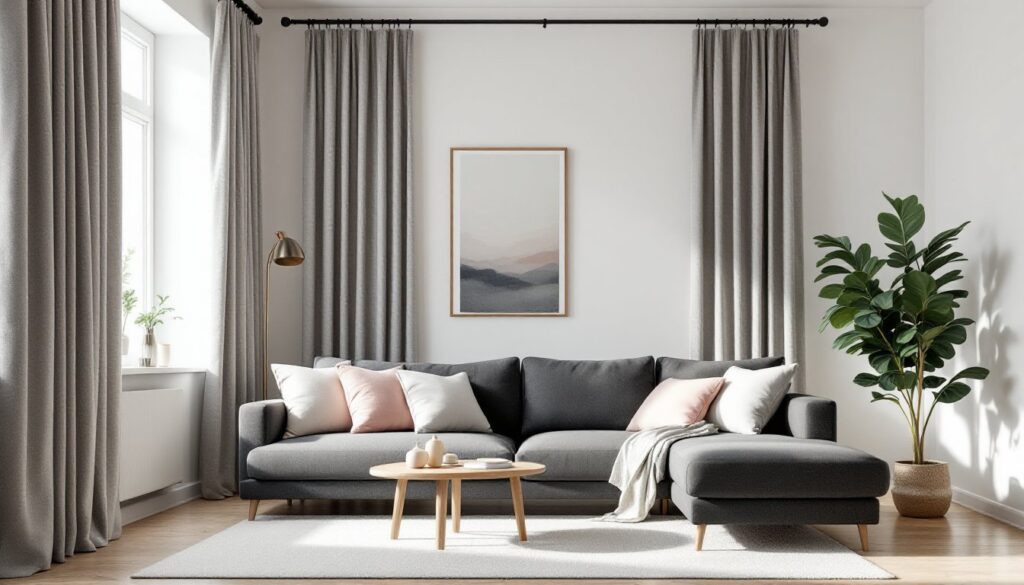
- Grey + blush pink + natural wood = soft contemporary
- Grey + mustard yellow + charcoal = bold but balanced
- Grey + sage green + cream = calming, organic modern
Pull one accent color from throw pillows, rugs, or artwork to create visual threads throughout the space.
Hardware and rods: The curtain rod is part of the design. For modern spaces, consider:
- Matte black rods for crisp contrast and industrial edge
- Brushed nickel or stainless steel for a sleek, contemporary look
- Natural wood or bamboo to add warmth and texture
- Brass or gold for a touch of glam (works especially well with warm greys)
Rod diameter matters, use 1-inch rods for lightweight curtains, 1.5-inch for medium-weight, and 2-inch for heavy velvet or blackout drapes. Undersized rods sag and look flimsy.
Hanging height and width: This is where most DIYers go wrong. For a modern, designer look:
- Hang the rod 4-6 inches above the window frame, or go all the way to the ceiling to make the room feel taller
- Extend the rod 6-12 inches beyond each side of the window so curtains can stack off the glass when open, maximizing light
- Choose curtain panels that just kiss the floor or puddle slightly (0.5-1 inch) for a luxe feel, never leave them floating mid-wall
Many decorating ideas showcase floor-to-ceiling curtains that create dramatic vertical lines and make standard 8-foot ceilings feel loftier.
Texture mixing: Grey’s neutrality makes it perfect for layering textures. Pair smooth grey curtains with a chunky knit throw, a jute rug, and velvet pillows. The variety keeps the room from feeling flat or one-note.
Pattern play: Solid grey curtains are the safe choice, but subtle patterns can add interest:
- Thin white or black stripes for a graphic punch
- Tone-on-tone geometric prints for texture without busyness
- Ombre grey (light to dark fade) for a modern, artistic touch
Avoid overly busy patterns, modern design leans toward restraint.
Installation and Hanging Guide for a Professional Look
Proper installation makes the difference between curtains that look DIY and curtains that look custom.
Tools and materials needed:
- Curtain rod and mounting brackets
- Level (a 24-inch or longer torpedo level works well)
- Tape measure
- Pencil
- Drill with appropriate bits
- Wall anchors (if not mounting into studs)
- Stud finder
- Safety glasses
Step-by-step hanging:
-
Measure and mark. Determine rod placement (typically 4-6 inches above the window frame or at ceiling height). Use the level to mark a perfectly horizontal line where the brackets will mount. Nothing screams amateur like crooked curtains.
-
Locate studs. Use a stud finder to locate wall studs near the bracket positions. Mounting into studs provides the strongest hold, especially for heavy curtains. Mark stud locations with pencil.
-
Install brackets. If mounting into studs, drill pilot holes slightly smaller than the screw diameter, then drive screws directly into the stud. If mounting into drywall, drill holes for wall anchors, use toggle bolts or molly bolts for curtains heavier than 10 pounds. Plastic expansion anchors are fine for lightweight sheers.
-
Check level again. Before fully tightening, double-check that brackets are level. Even 1/8-inch off becomes obvious once curtains are hung.
-
Hang the rod. Thread curtain panels onto the rod (unless using ring clips), then place the rod into the brackets. Some brackets have set screws to lock the rod in place, don’t skip these.
-
Adjust and style. Arrange the curtain pleats or folds evenly. For a modern look, create loose, uniform waves rather than tight, fussy pleats. Let the fabric hang for 24-48 hours to relax and settle before making final length adjustments.
Pro tips:
- For extra-wide windows (over 6 feet), add a center support bracket to prevent rod sag.
- If hanging ceiling-mounted curtains, use a stud finder to locate ceiling joists for the most secure installation. Drywall ceiling anchors can work but have weight limits.
- Grommet-top curtains slide easily but can look casual: rod pocket or back tab styles create a more tailored appearance: pinch pleat or ripplefold (with hardware) look the most custom but cost more.
- Steam or iron curtains before hanging to remove packaging creases, wrinkled curtains ruin the whole effect.
Common mistakes to avoid:
- Hanging curtains too short (they should nearly touch or just skim the floor)
- Using rods that are too narrow (curtains bunch over the window glass instead of stacking to the sides)
- Skipping wall anchors in drywall (the rod will eventually pull out)
- Not accounting for curtain weight when choosing hardware
Conclusion
Modern grey curtains offer versatility, sophistication, and practicality that few other window treatments can match. By choosing the right shade, fabric, and installation approach, anyone can achieve a polished, designer-level look without professional help. The key is measuring carefully, investing in quality hardware, and hanging them high and wide for maximum impact.