Table of Contents
ToggleA picture wall turns a blank expanse of drywall into a focal point that tells a story, anchors your seating area, and showcases what matters to you. Unlike single oversized art pieces, a gallery wall lets you layer texture, color, and memory into a flexible display you can rearrange as your collection grows. Whether you’re working with family photos, thrift-store prints, or museum-quality reproductions, the right layout and hardware turn a collection of frames into a cohesive design element. This guide covers proven layouts, installation techniques, and the small decisions, matting, spacing, hanging hardware, that separate a polished gallery wall from a haphazard cluster of frames.
Key Takeaways
- A picture wall transforms blank wall space into a focal point by layering multiple framed images, photos, and prints in deliberate patterns that tell a cohesive story and adapt as your collection grows.
- Grid layouts offer a clean, architectural aesthetic with uniform spacing (2–3 inches between frames), while salon-style arrangements embrace variety with mixed sizes and tighter clustering for a more eclectic, forgiving look.
- Proper planning with kraft paper templates and a laser level prevents costly mistakes; test your living room picture wall layout on the floor before installing any hanging hardware.
- Frame consistency is key to a polished appearance—stick to one frame finish or limit yourself to two complementary styles, and use standard 2–3 inch mats to maintain visual rhythm across varying print sizes.
- Thematic coherence, such as black-and-white photography, travel collections, or botanical prints, makes your picture wall feel intentional and ties it to your living room’s overall design style.
- For hanging hardware, use picture hangers rated for frame weight (nail-in hangers under 10 lbs, toggle anchors for heavier pieces) and start installation from the center, working outward for best balance.
What Is a Picture Wall and Why Should You Create One?
A picture wall (also called a gallery wall) is a curated arrangement of framed images, prints, or mixed media hung in a deliberate pattern on a single wall. It differs from standalone art in its cumulative visual impact, multiple pieces working together to fill vertical space and create rhythm.
The practical advantages are clear. Picture walls make use of awkward expanses above sofas, staircases, or narrow hallways where a single large frame would look lost. They’re also forgiving: if one frame feels off-balance, you can swap it out without repainting or patching a dozen holes. For renters or frequent movers, a modular gallery wall adapts to new rooms better than built-in shelving.
From a design standpoint, picture walls unify disparate frame styles and subject matter through intentional spacing and layout. A collection of mismatched thrift-store frames looks cohesive when hung in a grid with uniform gaps. A salon-style wall embraces variety, but the chaos is controlled by maintaining consistent mat borders or a unifying color palette.
There’s also the personal element. A living room picture wall can showcase travel memories, heirloom portraits, kids’ artwork, or a rotating selection of prints from local artists. Unlike a single statement piece, a gallery wall invites closer inspection and evolves over time.
Classic Gallery Wall Layouts That Never Fail
Choosing a layout determines your wall’s visual rhythm and ease of installation. The two most reliable approaches, grid and salon style, offer different aesthetics and difficulty levels.
Grid-Style Picture Walls
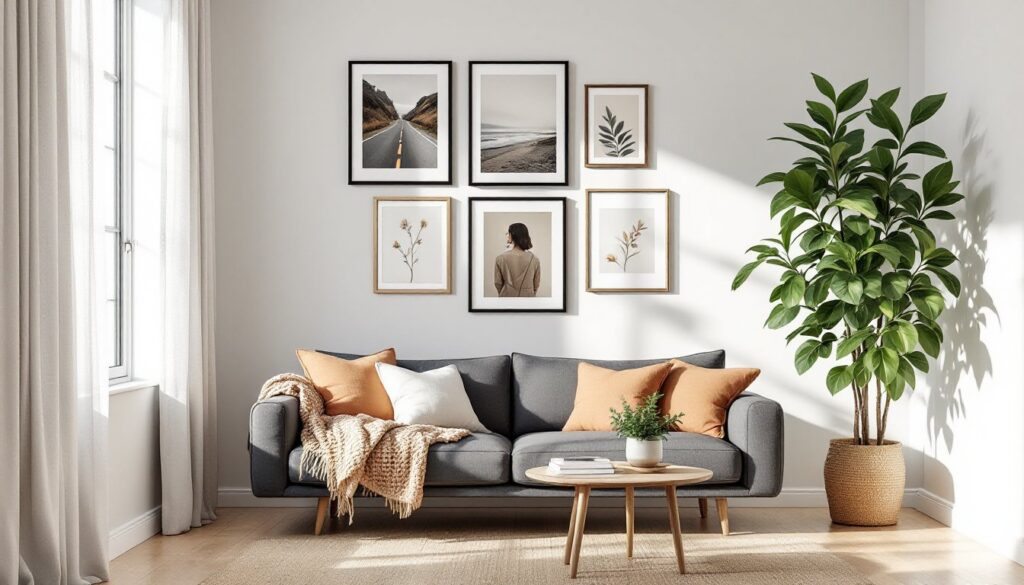
A grid layout arranges frames in evenly spaced rows and columns, creating a clean, architectural look. It works best when all frames share the same size and orientation (all 8×10″ verticals or all 11×14″ horizontals).
Installation steps:
- Measure your wall’s width and height. Leave at least 12–18 inches from the ceiling and adjacent walls to avoid a cramped look.
- Calculate spacing. A 2–3 inch gap between frames is standard. For a 3×3 grid of 8×10″ frames with 2″ spacing, you’ll need roughly 30″ wide by 34″ tall.
- Cut a paper template for each frame. Tape them to the wall with low-tack painter’s tape to test placement before committing to holes.
- Mark the center top of each template where the hanger will sit. Measure down from the frame’s top edge to the hanging wire or sawtooth bracket when taut, this offset is critical.
- Install picture hangers (like OOK or Hillman hangers rated for your frame weight) or drywall anchors if you’re not hitting studs. Standard frames under 10 lbs do fine with a single nail-in hanger: heavier frames need two points of contact or a toggle anchor.
Grids demand precision. Use a laser level or a 4-foot builder’s level to ensure rows stay horizontal. Small errors compound across multiple frames.
Salon-Style Eclectic Arrangements
Salon style mimics 18th-century European galleries: frames of varying sizes, orientations, and subjects clustered tightly with minimal negative space. It’s more forgiving of mixed frame styles but requires a good eye for balance.
Planning a salon wall:
- Start with your largest or most visually dominant piece as an anchor. Center it at eye level (57–60 inches to the center of the frame), which is the museum standard.
- Build outward, alternating smaller and medium frames. Odd numbers (3, 5, 7 pieces) feel more dynamic than even groupings.
- Maintain consistent gaps, 1.5–2 inches between frames keeps it from looking cluttered.
- Balance visual weight. A large dark frame on one side should be offset by clustered smaller frames or a bright print on the other.
Lay out the entire arrangement on the floor first. Take a photo from above to reference during installation. For salon walls, template paper is essential, rearranging tape is easier than patching multiple pilot holes.
Many designers recommend tying salon walls together with a cohesive color scheme that repeats across frames or mats, even when subjects vary.
Creative Picture Wall Themes for Every Living Room Style
Thematic coherence makes a picture wall feel intentional rather than random. Match your theme to your living room’s existing style and function.
Black-and-white photography walls suit modern, minimalist, or Scandinavian interiors. High-contrast prints in matching black frames create impact without competing for attention. Works well over neutral sofas or alongside industrial metals and concrete.
Travel and map collections layer vintage maps, ticket stubs in shadow boxes, and framed postcards. Anchor the wall with a large-scale map (30×40″ or bigger) and surround it with smaller destination photos in slim frames. Pairs naturally with mid-century or eclectic living rooms.
Botanical prints and nature themes bring organic texture to farmhouse, cottage, or traditional spaces. Mix pressed botanicals under glass, vintage field guide pages, and nature photography. Wooden or gilded frames reinforce the natural motif.
Family photo timelines organize chronologically or by generation. Use matching frames and mats for a cleaner look, or embrace a salon-style mix if the photos span decades and print sizes vary. This approach works in any style but feels especially at home in transitional or traditional living rooms.
Mixed media and texture walls combine framed prints with canvas art, metal signs, woven wall hangings, or floating shelves. This is the most flexible option but requires careful attention to scale and balance. Keep a unifying element, consistent metal finishes, a shared color palette, or uniform spacing.
According to contemporary design trends, layering textures and materials prevents picture walls from reading as flat or one-dimensional, especially in larger living rooms.
How to Plan and Install Your Living Room Picture Wall
Proper planning prevents the frustration of multiple patch-and-repaint cycles. Follow this sequence for clean, level results.
Step 1: Assess the wall.
Check for studs using a stud finder. Mark stud locations lightly with pencil. Hanging into studs isn’t always necessary for lighter frames, but if you’re installing a large or heavy piece, a stud-mounted screw provides the most secure hold. Avoid walls with light switches, outlets, or HVAC vents that break up your layout.
Step 2: Gather materials and tools.
- Picture hangers (rated for frame weight)
- Drywall anchors (toggle or screw-in style for frames over 15 lbs)
- Hammer or drill
- Laser level or 4-foot builder’s level
- Measuring tape and pencil
- Kraft paper or newspaper for templates
- Painter’s tape
Step 3: Create full-scale templates.
Trace each frame onto kraft paper and cut out. Mark the hanger position on each template. Tape the templates to the wall and step back to evaluate spacing, balance, and alignment.
Step 4: Install hardware.
Start from the center and work outward. For frames under 10 lbs, a single nail-in hanger into drywall is sufficient. For heavier pieces, use two hangers spaced to match the frame’s wire or D-rings, or install a drywall anchor rated for the load.
If you’re hanging multiple rows, level the top row first, then use a measuring tape to ensure consistent vertical spacing between rows.
Step 5: Hang and adjust.
Hang the center or anchor piece first, then build outward. Use a small level atop each frame to confirm it’s horizontal. If a frame tilts, adjust the hanger slightly or add adhesive bumpers (felt pads) to the bottom corners to stabilize.
Safety note: Wear safety glasses when hammering overhead or drilling into drywall, drywall dust and debris can fall directly into your eyes.
For renters or anyone hesitant about multiple holes, Command Picture Hanging Strips (the heavy-duty versions rated for 16 lbs per set) work for smaller frames on smooth painted walls. They won’t hold up on textured drywall or with gallery-weight pieces.
Choosing the Right Frames and Matting
Frames and mats unify a picture wall visually and protect your prints. The wrong choices can make even a well-hung layout look amateurish.
Frame materials and finishes:
- Wood frames (oak, walnut, maple) add warmth and suit traditional, farmhouse, or mid-century styles. Stain or paint them to match trim or furniture.
- Metal frames (aluminum or steel) in black, brass, or brushed nickel work in modern, industrial, or minimalist spaces. They’re lightweight and less prone to warping.
- Composite or MDF frames are budget-friendly and come pre-finished in dozens of colors. They’re heavier than metal but lighter than solid wood.
For a cohesive gallery wall, stick to one frame style and finish, or limit yourself to two complementary finishes (e.g., black metal and natural wood).
Matting:
A mat (or mount) is the border between the frame and the image. Standard mat width is 2–3 inches on all sides. Wider mats (4–6 inches) add formality and work well for smaller prints in larger frames.
Mats serve three purposes: they create visual breathing room, prevent the print from touching the glass (which can cause moisture damage or sticking), and allow you to frame odd-sized prints in standard frame sizes. An 8×10″ frame with a mat can hold a 5×7″ photo.
White and off-white mats are the most versatile. Black mats add drama but can overwhelm lighter prints. Colored mats should echo a dominant color in the image.
Many modern design approaches favor frameless or edge-to-edge framing for a gallery-minimalist look, but this works best with archival-quality prints that won’t curl or fade.
Pro tip: Buy frames with real glass (not acrylic) for archival photos or valuable prints. Glass doesn’t scratch as easily and provides better UV protection. For high-traffic areas or homes with kids, acrylic (plexiglass) is safer, it won’t shatter.
If you’re mixing frame sizes, keep mat widths consistent to maintain visual rhythm.