Table of Contents
ToggleThe right chandelier can completely redefine a small living room. Where recessed lights fall flat and table lamps clutter surfaces, a modern chandelier offers dramatic vertical interest without stealing precious floor space. Unlike traditional fixtures loaded with crystals and ornate details, today’s chandeliers feature clean lines, sculptural forms, and thoughtful proportions designed specifically for compact environments. Installing one isn’t complicated, most homeowners with basic electrical knowledge can swap out an existing fixture in an afternoon, but choosing the right piece requires understanding scale, height, and how light interacts with limited square footage.
Key Takeaways
- A modern chandelier for small living rooms creates vertical visual interest and draws the eye upward, making spaces feel larger without occupying precious floor space.
- Choose a chandelier size by adding your room’s length and width in feet and converting to inches—most small living rooms under 200 square feet work best with fixtures 16–24 inches in diameter.
- Ensure the fixture hangs 30–36 inches above the coffee table and account for your ceiling height (maximum 12-inch drop for 8-foot ceilings) to prevent a cramped or overwhelming appearance.
- Select LED bulbs with a warm color temperature of 2700–3000K and a CRI of 90+ for comfortable, accurate lighting that requires 1,500–3,000 lumens for adequate ambient light.
- Verify your existing electrical box is metal and rated for ceiling fans (50+ pounds capacity) before installation, and turn off power at the breaker while using a voltage tester for safety.
- Install a dimmer switch with compatible dimmable LED bulbs to transform your modern chandelier into a versatile lighting system that extends bulb life and adapts to different moods and activities.
Why a Modern Chandelier Works Perfectly in Small Living Rooms
Small living rooms face a fundamental design challenge: how to add visual weight and personality without crowding the space. A modern chandelier solves this by drawing the eye upward, creating the illusion of higher ceilings and more volume. That vertical emphasis matters in rooms measuring 150 square feet or less, where every horizontal surface counts.
Unlike floor lamps that occupy corner real estate or bulky pendant clusters that visually chop up sight lines, a single centered chandelier leaves walls and floors open. This becomes critical in spaces where a sofa, media console, and coffee table already push the limits of comfortable circulation. The fixture acts as functional sculpture, it provides ambient light while serving as the room’s focal point.
Modern designs strip away the bulk of traditional chandeliers. Instead of tiered crystal arms spanning 30+ inches, contemporary fixtures use materials like matte black metal, brushed brass, and geometric glass globes to achieve presence without mass. A well-chosen piece measuring 18-24 inches in diameter can anchor a room that would feel overwhelmed by a conventional fixture half again as large.
The practical benefits extend beyond aesthetics. Chandeliers with multiple bulb sockets (typically 4-8 in compact models) deliver more even illumination than single-source fixtures. This reduces harsh shadows in corners and eliminates the need for multiple supplementary lamps. For renters and owners alike, modern lighting fixtures offer simple installation that makes immediate impact without structural changes or drywall work.
Choosing the Right Size and Scale for Your Space
The chandelier-to-room proportion follows a straightforward formula, but small spaces require extra attention to avoid overpowering the room. Start by adding the room’s length and width in feet, then convert that sum to inches, that’s the maximum recommended diameter. For a 12′ × 14′ living room, the math yields a 26-inch fixture. In practice, most small living rooms (under 200 square feet) work best with chandeliers between 16 and 24 inches in diameter.
Height matters as much as width. The bottom of the fixture should hang 30 to 36 inches above the coffee table if positioned over a seating area, or at least 7 feet above the floor in open circulation zones. These clearances prevent head strikes and maintain proper light distribution. If the ceiling is 8 feet (standard in many homes), that leaves minimal room for a chandelier with significant drop length, opt for flush-mount or semi-flush styles that sit closer to the ceiling plane.
Ceiling height creates hard limits. For 8-foot ceilings, choose fixtures with a total drop (canopy to bottom) of 12 inches or less. Nine-foot ceilings accommodate drops up to 18 inches. Anything beyond that risks making the room feel compressed. Adjustable-height fixtures with chain or rod options provide flexibility, but always account for the adjusted measurement before purchasing.
Visual weight differs from physical dimensions. An open-frame chandelier measuring 22 inches across feels lighter than a solid drum shade of the same diameter. Sputnik designs with thin arms and exposed bulbs punch above their weight class in terms of presence while maintaining an airy profile. When shopping, consider how the fixture reads from the sofa, does it anchor the space or dominate it? In rooms where the design balances multiple elements, the chandelier should complement rather than compete.
Top Modern Chandelier Styles for Compact Living Areas
Minimalist and Geometric Designs
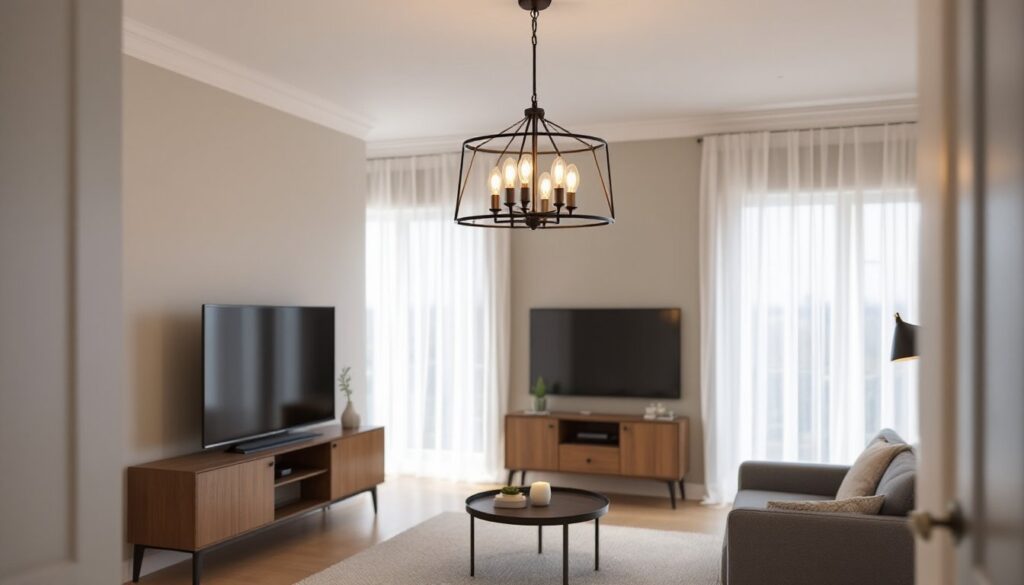
Minimalist chandeliers built from metal frames and simple glass globes offer maximum impact with minimal visual clutter. These fixtures typically feature clean lines, think rectangular cages, circular hoops, or hexagonal frames, that define space without blocking sightlines. A popular configuration uses a single metal ring (18-20 inches diameter) suspending 4-6 small globe bulbs at staggered heights.
The finish choice matters for small rooms. Matte black creates sharp contrast against white ceilings and works in industrial or Scandinavian schemes. Brushed brass or champagne gold adds warmth without the formality of polished finishes. Brushed nickel remains neutral enough for transitional spaces where homeowners plan to change wall colors or furniture over time.
Geometric designs in cube, sphere, or linear bar formats work particularly well over rectangular coffee tables or sectional sofas. A linear chandelier measuring 24-30 inches long and only 6 inches wide provides the footprint of a larger fixture while maintaining a slim profile. These install using standard junction boxes but may require minor chain or rod adjustments to level properly.
Sputnik and Mid-Century Modern Options
Sputnik chandeliers, characterized by arms radiating from a central sphere, make bold statements in small spaces without overwhelming them. The key is selecting versions with thin arms (½-inch diameter or less) and a modest arm span. A 12-arm Sputnik measuring 20 inches across delivers drama while keeping the visual mass low. Many use exposed bulb sockets, so bulb choice becomes part of the design (more on that in the lighting section).
Mid-century modern fixtures blend organic shapes with industrial materials. Look for designs featuring starburst patterns, tapered cone shades, or atomic-era silhouettes in period-accurate finishes like aged brass or oil-rubbed bronze. These styles pair naturally with mid-century furniture pieces common in compact urban spaces.
One practical advantage: most Sputnik and mid-century designs use E26 medium-base sockets compatible with standard LED bulbs. This keeps operating costs low (typically under $15 annually for LED bulbs run 4 hours daily) and simplifies bulb replacement. Avoid vintage-reproduction fixtures requiring hard-to-find specialty bulbs unless you’re prepared to source replacements long-term.
Installation Tips and Placement Strategies
Before purchasing any chandelier, confirm the existing electrical box can support the weight. Standard plastic pancake boxes hold only 10-15 pounds, insufficient for most chandeliers. Metal boxes rated for ceiling fans (typically holding 50+ pounds) provide adequate support for fixtures up to 30 pounds. If the existing box is inadequate, a retrofit fan-rated box can be installed through the ceiling using an adjustable brace bar that spans between joists. This requires attic access or cutting a small inspection hole.
Turn off power at the breaker, not just the wall switch. Use a non-contact voltage tester to verify the circuit is dead before touching any wires. Most modern chandeliers use straightforward wiring: black (hot) to black, white (neutral) to white, and bare copper (ground) to the box’s ground screw or wire. Wire connections require wire nuts sized to the gauge and number of wires being joined, typically 12 or 14 AWG in residential lighting circuits.
Chandelier weight and balance affect installation. Heavier fixtures benefit from a helper holding the chandelier while the installer makes electrical connections and secures the mounting bracket. The canopy (decorative cover plate) should sit flush against the ceiling. Gaps indicate the mounting hardware isn’t properly adjusted or the ceiling isn’t level.
Placement depends on room layout. In square rooms, center the fixture in the ceiling for balanced light distribution. In rectangular spaces, consider centering it over the primary seating area rather than the room’s geometric center, this often means positioning it above the coffee table. Measure twice before installation. A fixture hung off-center by even 6 inches creates noticeable visual tension.
Safety note: If the existing wiring shows frayed insulation, burn marks, or the circuit frequently trips, call a licensed electrician before proceeding. Aluminum wiring (common in homes built 1965-1975) requires special connectors and techniques, not a DIY project for most homeowners. Local electrical codes, based on the National Electrical Code (NEC), vary by jurisdiction. Some municipalities require permits for fixture replacement beyond simple like-for-like swaps.
Lighting Considerations: Brightness, Bulbs, and Dimming
Small living rooms require 1,500 to 3,000 lumens for adequate ambient lighting, depending on ceiling height, wall color, and natural light availability. A chandelier with six bulb sockets using 60-watt-equivalent LED bulbs (approximately 800 lumens each) delivers 4,800 lumens, often too bright without dimming capability. For spaces under 150 square feet, aim for the lower end of the range and supplement with task lighting as needed.
LED bulbs offer the best combination of energy efficiency, longevity, and light quality. Choose bulbs with a color temperature between 2700K and 3000K for warm, inviting light similar to incandescent bulbs. Avoid cool white (4000K+) in living spaces, it reads as clinical rather than comfortable. The Color Rendering Index (CRI) matters for spaces where you watch TV or display art: a CRI of 90+ ensures colors appear accurate.
Bulb shape affects how the fixture looks when lit. Exposed-bulb chandeliers show the bulb as part of the design. Globe bulbs (G16, G25) or vintage Edison-style bulbs enhance mid-century and industrial fixtures. Shaded or enclosed fixtures hide the bulb, making standard A19 bulbs perfectly acceptable. Always check the fixture’s maximum wattage rating (often 40-60 watts per socket), LED equivalents stay well under this limit but verify to avoid voiding warranties.
Installing a dimmer switch transforms a single fixture into a versatile lighting system. Dimming to 50% for movie watching or evening conversation extends bulb life and reduces energy use. Not all LED bulbs dim smoothly, look for bulbs specifically labeled “dimmable” and pair them with LED-compatible dimmers. Incompatible combinations cause flickering, buzzing, or limited dimming range (only working at 80-100% brightness).
A dimmer installation requires replacing the existing switch with a compatible dimmer. Single-pole dimmers (controlling one fixture from one location) cost $15-40 and install in 15 minutes for anyone comfortable with basic wiring. Turn off the breaker, remove the old switch, connect the dimmer’s wires (typically two black and one green ground), secure the device in the box, and attach the faceplate. If the circuit is controlled from multiple locations (three-way switching), you’ll need a three-way dimmer plus compatible remote switch, a more complex installation that may warrant an electrician.
Consider beam angle for multi-bulb fixtures. Bulbs with narrow beam angles (25-40 degrees) create focused pools of light beneath the chandelier. Wide angles (100+ degrees) spread light more evenly. Small rooms generally benefit from wider beam patterns that fill the space rather than creating hot spots and shadows.