Table of Contents
ToggleA chandelier isn’t just a light fixture, it’s the jewelry of a living room. Modern chandeliers have evolved far beyond crystal teardrops and ornate metalwork. Today’s designs lean geometric, industrial, organic, and minimalist, transforming living spaces with sculptural presence and smart lighting. Whether the room measures 12×12 feet or sprawls across an open-concept floor plan, choosing the right fixture involves balancing scale, style, electrical logistics, and safety. This guide walks through design language, sizing formulas, installation best practices, and how to make a chandelier the centerpiece it deserves to be.
Key Takeaways
- Modern chandelier living room designs prioritize clean lines, geometric shapes, and materials like brushed nickel and matte black steel over ornate traditionalism.
- Correctly size a modern chandelier by adding your room’s length and width in feet, then converting to inches—for example, a 14×16-foot room calls for a 30-inch diameter fixture.
- Position the chandelier 7 to 7.5 feet above the floor in standard ceilings, with 30–36 inches of clearance above furniture for both visual impact and safety.
- Match or intentionally contrast metal finishes with surrounding décor, and layer your lighting with table and floor lamps to create flexibility from bright task light to ambient mood.
- Verify your ceiling electrical box is rated for the chandelier’s weight before installation, and hire a licensed electrician if you lack experience with electrical work or encounter aluminum wiring.
What Makes a Chandelier ‘Modern’? Key Design Elements
Modern chandeliers break from traditional symmetry and ornamentation. They prioritize clean lines, unexpected materials, and architectural form over fussy details.
Materials commonly include brushed nickel, matte black steel, raw brass, Edison bulbs, glass globes, acrylic rods, and even wood or concrete. The finish matters, high-gloss chrome reads retro-futuristic, while powder-coated matte finishes feel restrained and Scandinavian.
Form tends toward geometric shapes: hexagons, starburst clusters, linear suspensions, or asymmetrical branch configurations. Some designs feature exposed bulbs as intentional focal points, while others use alabaster or frosted glass to diffuse light softly.
Scale and negative space also define modern fixtures. Instead of densely packed crystals, contemporary chandeliers often incorporate open frameworks, suspended elements, or floating canopies that create visual interest without overwhelming a room. Designs featured on platforms like Design Milk often showcase how industrial materials and minimalist silhouettes redefine traditional lighting categories.
Modern doesn’t mean cold. Organic touches, like woven rattan shades, hand-blown glass, or driftwood accents, bring warmth without veering traditional. The key is intentionality: every element serves the design, not just decoration.
Choosing the Right Size and Scale for Your Living Room
A chandelier that’s too small disappears. Too large, and it dominates like a spaceship. Sizing isn’t guesswork, there are formulas.
Diameter formula: Add the room’s length and width (in feet), then convert that sum to inches. For a 14×16-foot living room, that’s 14 + 16 = 30 inches in diameter. This is a starting guideline, not gospel. Open-concept spaces or rooms with vaulted ceilings can handle slightly larger fixtures.
Ceiling height matters. Standard 8- to 9-foot ceilings work well with chandeliers 20 to 27 inches tall. For every additional foot of ceiling height, add 3 inches to the fixture’s height. A room with 12-foot ceilings can accommodate a chandelier up to 36 inches tall without feeling cramped.
Proportion to furniture: If the chandelier hangs over a coffee table or seating area, its diameter should be roughly one-half to two-thirds the width of the table beneath it. A 48-inch round coffee table pairs well with a 24- to 32-inch chandelier.
Consider the chandelier’s visual weight, too. An open-frame starburst fixture with slim arms can go larger than a dense globe chandelier of the same diameter. Step back and assess bulk, not just measurement.
If unsure, mock it up. Cut a piece of cardboard to the fixture’s diameter and hang it from the ceiling with painter’s tape. Live with it for a day. It’s easier to adjust on paper than after installation.
Popular Modern Chandelier Styles for Living Rooms in 2026
Trends shift, but certain styles have staying power in modern design.
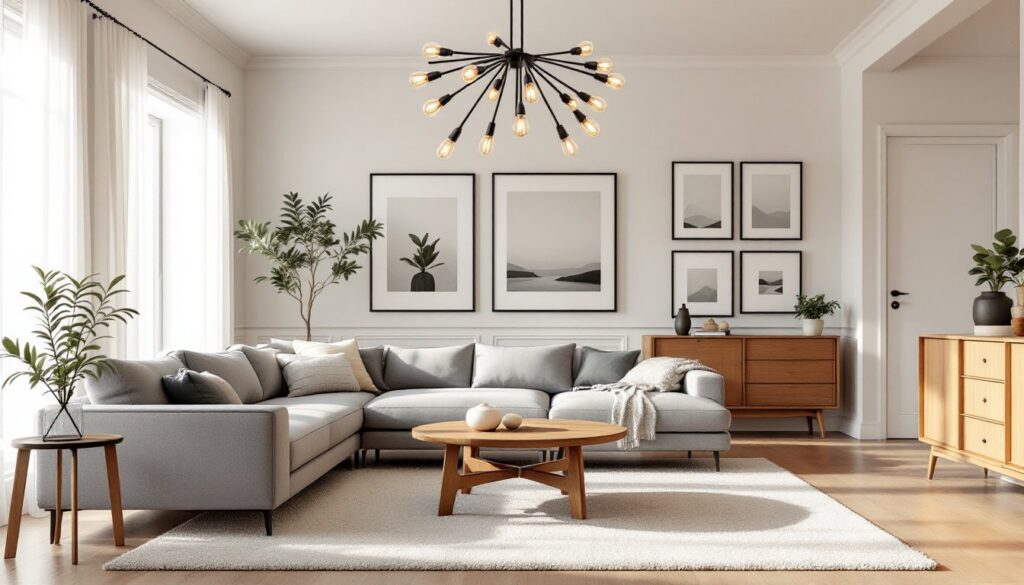
Sputnik chandeliers remain iconic: radiating arms tipped with bulbs, mid-century inspired, and endlessly adaptable. They work in both vintage-modern and industrial settings. Sizes range from compact 18-inch models to dramatic 40-inch statement pieces.
Linear suspension chandeliers fit rectangular or long living rooms. These fixtures, often 40 to 60 inches in length, feature bulbs or shades arranged in a row, ideal for open-concept layouts where a single pendant feels lost. They provide even illumination and suit contemporary farmhouse or minimalist interiors.
Globe cluster chandeliers group multiple glass or metal spheres at varying heights. They add organic movement and layer light beautifully. Adjustable cord lengths let homeowners customize the silhouette.
Wagon wheel and ring chandeliers made from blackened steel or brass bring an industrial edge. Modern iterations strip away rustic heaviness, favoring slender profiles and Edison bulbs.
Organic and sculptural designs, like driftwood branches, woven rattan drums, or hand-formed ceramic elements, are gaining traction in 2026. Publications such as Dwell frequently highlight how sustainable materials and artisan craftsmanship intersect with modern lighting.
Smart-enabled chandeliers with integrated LED modules, dimming capability, and app control are no longer niche. Look for fixtures compatible with standard smart home systems if automation matters.
Choose a style that complements existing architecture. A Sputnik fits a mid-century ranch: a geometric cage chandelier suits a loft with exposed ductwork.
Placement and Height Guidelines for Maximum Impact
Hanging a chandelier at the wrong height kills its effect and creates hazards.
General living room rule: The bottom of the chandelier should hang 7 to 7.5 feet above the floor in rooms with standard 8- to 9-foot ceilings. This keeps the fixture out of sightlines and away from tall guests.
For rooms with higher ceilings, raise the chandelier proportionally but maintain visual balance. In a two-story living room with 16-foot ceilings, the chandelier can hang 9 to 10 feet above the floor, but it should still relate to the furniture zone below, not float in dead space.
Over a coffee table or seating area: Aim for 30 to 36 inches of clearance between the table surface and the fixture’s lowest point. This ensures the chandelier feels anchored to the space without obstructing conversation or views across the room.
Centered or off-center? In a traditional layout, center the chandelier in the room. In open-concept or asymmetrical spaces, center it over the main seating cluster or architectural focal point (like a fireplace wall), not necessarily the room’s geometric center.
Multiple fixtures: Long or L-shaped living rooms sometimes benefit from two smaller chandeliers instead of one oversized piece. Space them evenly and ensure each relates to a distinct furniture grouping.
Always account for chain or cord length. Most chandeliers ship with adjustable hanging hardware: don’t assume the out-of-box length is correct. Measure twice, adjust once.
DIY Installation Tips and When to Call an Electrician
Installing a chandelier is intermediate-level electrical work. If comfortable replacing a ceiling fan, this is doable. If not, hire a licensed electrician.
Safety first: Shut off power at the breaker, not just the wall switch. Use a non-contact voltage tester to confirm the circuit is dead before touching any wires. Wear safety glasses.
Tools needed:
- Voltage tester
- Wire strippers
- Screwdriver set (flathead and Phillips)
- Adjustable wrench
- Ladder (6-foot minimum for 8-foot ceilings)
- Wire nuts
- Optional: Ceiling box brace or pancake box (if existing box isn’t rated for the weight)
Check the electrical box: Chandeliers weigh more than standard fixtures. Verify the ceiling box is rated for the chandelier’s weight, typically stamped on the box itself. If the existing box is a lightweight plastic retrofit, replace it with a metal fan-rated box (most chandeliers require the same 50-pound capacity as ceiling fans). Pancake boxes work for fixtures under 35 pounds on solid framing.
Wiring: Modern chandeliers use standard connections, black (hot) to black, white (neutral) to white, and bare copper or green (ground) to the ground screw or wire. Match wire colors, twist clockwise, cap with wire nuts, and tug-test each connection.
Hanging heavy fixtures: Recruit a second person. One holds the chandelier while the other makes electrical connections and secures the mounting bracket. Chandeliers over 40 pounds require blocking or a brace bar installed between ceiling joists.
Dimmer compatibility: If installing a dimmer, confirm the chandelier’s bulbs are dimmable (especially LED). Not all LEDs play nice with all dimmers, check manufacturer specs to avoid flickering.
When to call a pro: If there’s no existing ceiling box, if wiring is aluminum (common in homes built 1965–1975), if adding a new circuit, or if anything about the setup feels uncertain. Electrical errors cause fires. The National Electrical Code (NEC) requires proper box support and grounding: local jurisdictions may require permits for new circuits or structural modifications.
For style advice on integrating the fixture into the room once installed, resources like MyDomaine offer detailed room-by-room guidance.
Pairing Your Chandelier with Living Room Decor
A chandelier sets the tone, but it needs supporting players.
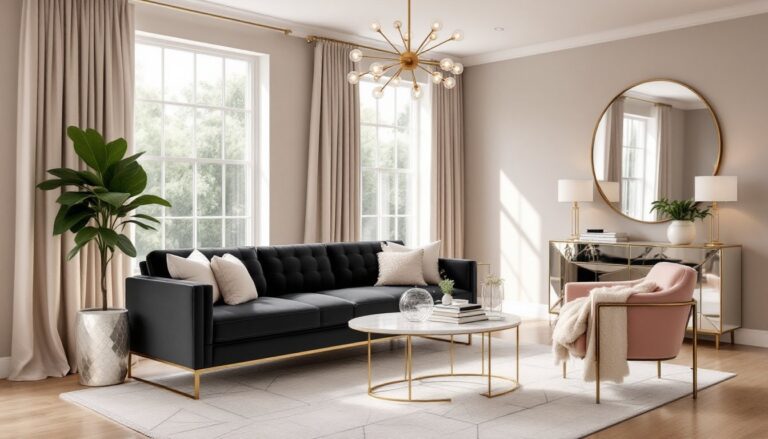
Finish coordination: Match or intentionally contrast metal finishes. If the chandelier is matte black, echo that in curtain rods, picture frames, or cabinet hardware. Mixed metals work, brass chandelier with chrome accents, but keep it to two or three finishes max.
Bulb selection matters. Edison bulbs (vintage filament style) suit industrial or mid-century fixtures. Frosted LED bulbs soften contemporary designs. Aim for 2700K to 3000K color temperature for warm, livable light. Avoid cool white (4000K+) in living rooms, it feels clinical.
Layered lighting: A chandelier provides ambient light but shouldn’t be the only source. Add table lamps, floor lamps, or recessed lighting for task and accent layers. Use a dimmer so the chandelier can shift from bright task light to subtle mood lighting.
Furniture arrangement: Pull seating inward so the chandelier feels integrated, not isolated. If the fixture hangs over a coffee table, make sure the table is proportionate (see sizing guidelines above).
Color palette: Let the chandelier’s finish influence but not dictate wall color. A brass starburst pops against deep charcoal or crisp white. A black geometric cage chandelier grounds a room with soft grays and natural wood tones.
Avoid clutter above: Don’t hang the chandelier near ceiling fans, air vents blowing directly on it, or in a path where it competes with crown molding or coffered ceilings. Give it breathing room.
Test everything before the paint dries. Hang the chandelier, arrange furniture, turn on all lights at dusk, and live in the space for a week. Adjust as needed, it’s easier to tweak a chain length now than after the room is fully furnished.
Conclusion
A well-chosen modern chandelier transforms a living room from functional to intentional. It’s architecture, sculpture, and light source rolled into one. Size it right, hang it at the correct height, and pair it thoughtfully with the rest of the room. Whether tackling the install solo or hiring it out, the result should feel both dramatic and effortless, like it’s always belonged there.