Table of Contents
ToggleSwag curtains aren’t your grandmother’s window treatment anymore. While they’ve been around for decades, today’s versions blend the soft drape and architectural interest of traditional designs with clean lines and contemporary fabrics. They work particularly well in living rooms where you want to add visual height, frame a view, or soften the hard edges of modern furnishings without heavy pleats or formal valances. Installing them is straightforward, most hang from decorative hardware without complex rigging, and they’re forgiving enough for first-time DIYers. If you’re ready to move beyond flat panels or basic tabs, swag curtains offer a middle ground that’s elegant without being fussy.
Key Takeaways
- Modern swag curtains blend soft drapes with clean lines and contemporary fabrics, making them an elegant middle ground for living rooms that want visual interest without heavy pleats or formal valances.
- Linen, linen blends, and lightweight cotton voile are the best fabric choices for modern swag curtains because they drape naturally, diffuse light beautifully, and avoid the stiffness of synthetic materials.
- Mount swag curtain hardware 4 to 8 inches above the window frame and extend 2 to 4 inches beyond each side to create an illusion of height and width in your living room.
- Single swags work best for narrow windows with shallow drapes (6 to 12 inches), while double or triple swags suit wider windows and can be layered with functional panels underneath for light control.
- Pair swag curtains with solid or subtly textured furnishings in neutral tones like warm white, greige, slate gray, or dusty blue to let the drape’s organic shape be the focal point rather than competing with patterns.
- Swag curtains alone don’t provide blackout capability—install roller or cellular shades behind them for functional light control while maintaining the soft, elegant aesthetic.
What Are Modern Swag Curtains and Why They’re Making a Comeback
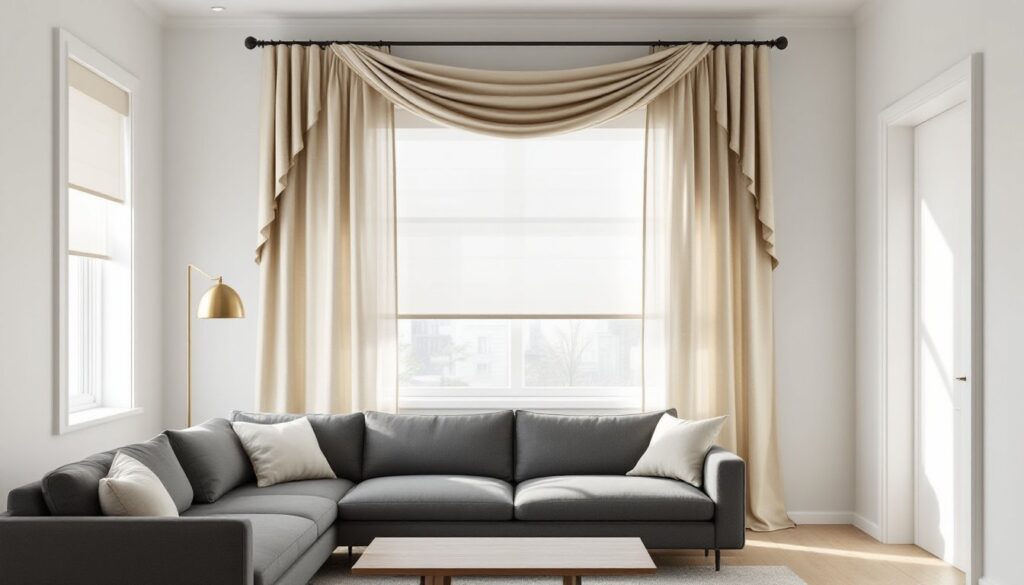
A swag curtain drapes fabric in a controlled curve, called a swag, between two mounting points, typically over a window or doorway. Unlike traditional heavy brocades with tassels and fringe, modern versions use lighter materials and simpler hardware. The fabric hangs naturally, creating soft folds that add dimension without blocking light or views.
The resurgence comes from a shift toward layered, textural interiors. Flat surfaces and minimalism dominated for years, but homeowners are reintroducing organic shapes and softer materials. Swag curtains deliver that effect efficiently: they break up long sight lines, add visual interest at the ceiling level, and introduce movement in a room full of static furniture.
They’re also practical. In rooms with high ceilings or oversized windows, floor-length panels can feel heavy or overwhelming. A swag across the top third of the window draws the eye up, emphasizes height, and can be paired with blinds or shades underneath for light control. They’re especially useful in open-plan living spaces where you want separation or focal points without installing permanent partitions.
From a design perspective, swags work because they’re adjustable. Deeper drapes create drama: shallow swags read cleaner and more tailored. You control the effect by how much fabric you use and where you position the hardware.
Choosing the Right Fabric and Color for Your Living Room
Best Fabrics for Contemporary Swag Curtains
Fabric choice determines both the silhouette and the practicality of your swag curtains. Linen and linen blends are top picks for modern interiors, they drape naturally without stiffness, diffuse light beautifully, and fit the relaxed-but-refined aesthetic most contemporary spaces aim for. Expect linen to wrinkle: that’s part of its character. If that bothers you, opt for a linen-polyester blend that holds its shape better while keeping the texture.
Lightweight cotton voile or cotton-silk blends work well if you want translucency and soft folds. These fabrics let natural light filter through while still providing privacy during the day. They’re best for south- or west-facing windows where you want to temper harsh light without heavy treatments.
For rooms where you need more structure or light-blocking capability, consider velvet or medium-weight cotton duck canvas. Velvet adds richness and depth, especially in jewel tones or muted neutrals, and it holds a swag shape with minimal effort. Cotton duck (the same material used for drop cloths, but finished) is durable, affordable, and hangs with clean lines, ideal if you’re going for an industrial-modern look.
Avoid overly stiff or synthetic fabrics like polyester taffeta. They don’t drape naturally and can look cheap under daylight. Also skip anything labeled “sheer” unless you’re layering it over blinds, it won’t have enough body to hold a swag curve.
Color Palettes That Complement Modern Living Spaces
Neutrals dominate modern swag curtain palettes, but “neutral” covers more ground than beige. Warm whites, greige (gray-beige blends), soft taupe, and oatmeal all work because they complement rather than compete with furniture and flooring. These tones also reflect light, which keeps the room feeling open.
If your living room skews cooler, think charcoal sofas, steel accents, concrete finishes, reach for slate gray, dusty blue, or cool linen white. These colors reinforce the modern vibe without adding visual clutter.
For contrast or a statement, consider deep terracotta, olive green, or charcoal. These work especially well in rooms with white or light wood trim, where the swag becomes an architectural accent rather than just a window dressing. Jewel tones like emerald or navy can also anchor a room, but they need enough natural light to avoid feeling heavy.
Patterns are trickier. Subtle textures, linen weaves, tone-on-tone stripes, or small geometric prints, add dimension without overwhelming the space. Large florals or busy patterns rarely suit modern swag applications: they fragment the drape and read as dated.
Popular Swag Curtain Styles for Modern Interiors
Single swag is the cleanest option: one continuous length of fabric draped between two holdbacks or finials, creating a gentle U-shape. It works well over narrow windows or French doors. Keep the drape shallow (6 to 12 inches) for a streamlined look, or go deeper (18 to 24 inches) for more drama.
Double or triple swag uses multiple fabric panels overlapping in a series of curves. This suits wider windows or picture windows where a single swag would stretch too thin. Each swag should be roughly equal in width and depth to maintain symmetry. This style requires more fabric and planning, but it adds rhythm and can make a large window feel more intentional.
Asymmetrical swag drapes from one side only, pooling or tailing off to one corner. It’s a good fit for corner windows or spaces where you want to emphasize vertical lines. This style has a relaxed, editorial feel, think the aesthetic you’d see on contemporary interior design platforms showcasing updated mid-century or Scandinavian homes.
Layered swag with panels combines a draped swag across the top with stationary or functional panels underneath. The swag provides the soft curve: the panels offer privacy or light control. This is the most versatile setup for living rooms where you need both style and function. It’s also forgiving: if the swag doesn’t hang perfectly, the panels below draw the eye downward and balance the composition.
Most swags are stationary, they don’t open or close. If you need adjustable coverage, mount blinds, shades, or an extra curtain rod behind the swag. Trying to make swag curtains functional usually compromises the drape.
How to Install Swag Curtains: A Step-by-Step DIY Guide
Tools and materials:
- Fabric (measure window width × 1.5 to 2 for fullness, plus desired drop)
- Curtain rod or swag holders (decorative hooks, holdbacks, or finials)
- Drill and appropriate bits (masonry bit for brick/concrete, standard bit for wood studs)
- Level and tape measure
- Pencil
- Wall anchors (if not mounting into studs or window framing)
- Safety glasses
Step 1: Measure and mark. Decide where your swag will sit. Most modern installations place holders 4 to 8 inches above the window frame and 2 to 4 inches beyond each side to create the illusion of a larger window. Mark these points lightly with a pencil. Use a level to ensure they’re even, uneven mounting points will make the swag look crooked no matter how carefully you drape it.
Step 2: Locate studs or framing. Use a stud finder along your marks. If you hit a stud or the window’s wooden framing, you can screw hardware directly in. If not, you’ll need drywall anchors rated for at least 10 lbs each, fabric, especially when layered, is heavier than it looks.
Step 3: Install hardware. Drill pilot holes (slightly smaller than your screws) to prevent splitting. Attach swag holders, decorative hooks, or rod brackets. If using a continuous rod, mount brackets and slide the rod through a rod-pocket hem in your fabric before securing the second bracket. If using holdbacks or hooks, you’ll drape the fabric over them in the next step.
Step 4: Drape the fabric. For a single swag, start at one holder, loop the fabric over it, let it drape to your desired depth, then bring it up and over the opposite holder. Adjust the depth and folds until both sides are even. For a double swag, find the center of your fabric, mark it, and start there, drape outward to each holder, creating two separate curves. Pin or tack the center point if needed to keep it in place.
Step 5: Adjust and secure. Step back and check symmetry. If one side hangs lower, pull a bit more fabric through the holder. Once satisfied, you can tack or pin the fabric to the holders (small safety pins on the backside work) to prevent shifting. Some holders have built-in clips or grips.
Safety note: Always wear safety glasses when drilling overhead. If mounting above a large window or on a ladder, have a second person steady the ladder or hand you tools.
No permits or special codes apply to curtain installation, but if you’re mounting into brick, concrete, or plaster, use appropriate anchors and bits. Toggle bolts or expansion anchors are necessary for hollow walls if you miss the stud.
Styling Tips to Maximize the Impact of Your Swag Curtains
Mount hardware higher and wider than the window. This is the single biggest impact move. Mounting even 6 inches higher makes ceilings feel taller and draws attention upward. Extending holders 3 to 4 inches past the window frame on each side makes the window (and room) appear wider. The effect is subtle but significant, especially in smaller living rooms.
Layer textures, not patterns. If you’re using swag curtains, keep upholstery and rugs in solid or subtly textured fabrics. The drape itself provides the organic shape and visual interest: competing patterns dilute that. Think linen swags over a wool rug and leather seating, not florals on florals.
Coordinate hardware finish with room metals. If your living room has brushed nickel lighting and matte black shelf brackets, pick curtain hardware in one of those finishes. Mixing too many metal tones, especially shiny brass with cool chrome, creates visual clutter. Swag curtains rely on simplicity: mismatched hardware undermines that.
Use swags to define zones in open-plan spaces. In a combined living-dining area, a swag over a large window or doorway can visually anchor the living zone. The curve creates a soft boundary without the hard line of a room divider. Pair this approach with rugs and furniture arrangement to reinforce the separation.
Don’t overthink symmetry if your room isn’t symmetrical. If you have an off-center window or an odd layout, an asymmetrical swag often looks more intentional than forcing a centered drape. Let the fabric fall naturally and use the weight of the fabric to your advantage, fighting the architecture rarely works.
Light layering matters. Swag curtains alone won’t give you blackout capability. If light control is important, install roller shades or cellular shades behind the swag. This combo gives you the softness of fabric with the function of adjustable coverage. In spaces where natural light is abundant, swags can highlight that feature, similar to how shower curtain ideas use fabric to frame and enhance small spaces without overwhelming them.
Avoid over-accessorizing. Skip the tassels, fringe, and tie-backs unless you’re deliberately going for a maximalist or traditional look. Modern swag curtains succeed because they’re understated. Let the drape and fabric quality do the work. If you want detail, invest in high-quality rods or sculptural holdbacks, not add-ons.
Keep proportions in check. In a room with 8-foot ceilings, a swag that drops 24 inches will eat up a quarter of your wall height and feel heavy. Stick to 8 to 12-inch drops. In spaces with 10-foot or higher ceilings, you can go deeper, 18 to 24 inches, without overwhelming the room. As noted by experts on platforms like Design Milk, proportion and restraint define successful modern interiors more than any single trend.
Finally, if you’re uncertain about drape depth or fabric quantity, buy extra. Fabric can always be hemmed or returned, but a skimpy swag looks unfinished. When in doubt, err on the side of more fullness, it’s easier to pull fabric tighter than to stretch it further.